
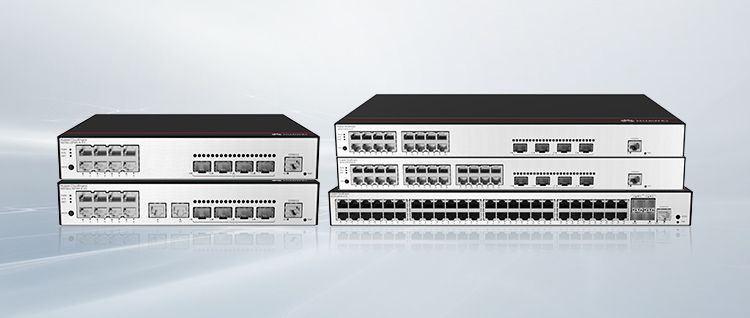
The CloudEngine S5735-L series from Huawei represents a powerful line of campus access switches designed for enterprise-grade networks. With flexible port configurations, high forwarding performance, and advanced features such as intelligent stacking and security controls, the S5735-L-V2 series is perfectly positioned for modern campus deployments. Built on next-generation hardware and software platforms, it supports a wide range of access scenarios—from small branch offices to large campus networks.
Purpose & Target Use Cases
The CloudEngine S5735-L-V2 is ideal for enterprise campus access where gigabit or multi-gigabit desktop connectivity is required. It is particularly suited for use cases such as:
▪ Access layer in campus LAN environments where lots of end-user devices (PCs, IP phones, Wi-Fi access points) must connect reliably.
▪ Network edge or aggregation in small to medium branch sites, offering uplinks to higher tiers while simplifying operations.
▪ Scenarios requiring intelligent stacking (iStack) and simplified O&M, enabling deployment and management at scale with more ease.
▪ Environments demanding advanced security, flexible Ethernet networking and Layer 3 support at the access layer. In other words, when your network demands high performance, flexibility and robust feature-sets at the access layer, the S5735-L-V2 is a compelling choice.
Key Technical Specifications
Below is a summary of representative specification highlights for the S5735-L-V2 series. Actual values depend on the specific model variant.
▪ Ports: 8/10/16/24/48 × 10/100/1000 Base-T downlink ports; 4 × GE or 10GE uplink ports; 2 × 12GE dedicated stack ports.
▪ Switching capacity: up to 520 Gbps system switching capacity in certain models.
▪ Forwarding performance: varying by model – for example, 18 Mpps for smaller variants; up to ~132 Mpps for larger ones.
▪ Stacking support: Dedicated 12GE stack ports providing high-speed stacking across units.
▪ PoE/PoE+ support: Some variants support PoE+ for powering devices like access points and IP phones.
▪ Security & routing: Supports multiple Layer 3 routing protocols, IEEE 802.1X authentication, MAC-based authentication, hybrid authentication and diversified user policies.
▪ Telemetry/monitoring: Real-time device data collection, integration with campus network analytics tools for proactive maintenance. These core specs highlight how the S5735-L-V2 series balances access-layer affordability with advanced features more commonly found in higher-tier switches.
Major Features & Highlights
Flexible Ethernet Networking
The S5735-L-V2 series supports rich Ethernet protocols that boost resiliency and flexibility. For example, it includes support for traditional Spanning Tree Protocol (STP), Rapid STP (RSTP), Multiple STP (MSTP), and the industry-leading Ethernet Ring Protection Switching (ERPS, ITU-T G.8032) which offers millisecond-level protection switching. In addition, “Smart Link” functionality allows an access switch to connect to multiple aggregation switches via multiple links, enhancing uplink reliability.
Intelligent Stacking (iStack)
The series supports Huawei’s iStack technology, enabling multiple switches to form one logical unit. This simplifies management and reduces configuration complexity. The high-speed stack ports (e.g., 12GE) ensure the stack backbone maintains high performance even in dense deployments.
High-Performance Hardware Platform
Built on next-generation forwarding engines, the S5735-L-V2 series provides high switching capacity and forwarding performance at the access layer. Whether for 8-port or 48-port variants, the architecture supports large throughput headroom for current requirements and future growth.
Advanced Security & Diversified Control
Security features are integral to the design. From 802.1X port authentication, MAC address authentication, to hybrid authentication, the switch supports granular user access policies (VLAN, QoS, ACL). It also defends against DoS attacks and unauthorized access, making it suitable for modern enterprise access networks.
Telemetry & Network O&M Intelligence
Telemetry technology enables the device to collect rich operational data in real time and integrate with tools like CampusInsight and Huawei’s iMaster NCE-CampusPlatform for analytics. This allows administrators to shift from reactive to proactive management, identifying issues before users notice them.
Model Variants & Selection Guidance
The S5735-L-V2 series covers a wide range of models with differing port counts, uplink types, PoE support and stacking capabilities. For example:
▪ Smaller models: 8 × 10/100/1000Base-T downlinks + 4 × GE SFP uplinks (non-PoE) with switching capacity around 24 Gbps/520 Gbps.
▪ Medium models: 10 × 10/100/1000Base-T + 4 × 10GE SFP+ uplinks or 16/24 ports variants, switching capacity ramping up to 100 Gbps or more.
▪ Larger models: 24 or 48 downlink ports, some with 10GE uplinks and 2 × 12GE stack ports, switching capacity reaching up to 176 Gbps or more in particular variants. When selecting a model: Consider port count needed for end-devices. Decide if PoE or PoE+ is required (for APs, IP phones, cameras). Determine uplink bandwidth needs (GE vs 10 GE). Plan for stacking or standalone use. Evaluate future growth so you avoid under-spec’ing the switch.
Performance & Scalability Considerations
Performance is a significant highlight of this series. With high switching capacity (e.g., system switching up to 520 Gbps) and stack-capable backbone, the access layer can scale and perform without becoming a bottleneck. In addition, scalability is enhanced via stacking—allowing multiple units to be managed as one logical entity—simplifying configuration and reducing head-count for network operations. Also, the telemetry capabilities enable visibility across stacked units and the wider network.
Operational Simplicity & Management Features
Operational simplicity is key. Because the device supports features such as telemetry, stack management, and unified OS platform (Huawei VRP), day-to-day tasks like configuration, monitoring, firmware updates, and fault diagnosis become much easier. The inclusion of analytics tools means administrators spend less time firefighting and more time optimizing the network.
Security & Access Control at the Edge
As the access layer becomes increasingly vulnerable, the S5735-L-V2 addresses security with depth. From port-level authentication to dynamic user policy application (VLAN, ACL, QoS based on user identity), the switch helps enforce network segmentation and control. It also includes features to detect and block unauthorized DHCP servers, mitigate DHCP snooping attacks, and apply event-driven security policies.
Energy Efficiency & Reliability
While delivering significant performance, the S5735-L-V2 also considers efficiency and reliability. Some models exhibit low typical power consumption when idle or lightly loaded for access-layer environments. For example, one variant reported typical power consumption of ~48.64 W in standard mode. Reliability is also built-in, with high MTBF (mean time between failure) values, redundant stacking and hardware platforms designed for enterprise availability.
Deployment Scenarios & Best Practices
When deploying the S5735-L-V2 series, here are some best practices: Use stacking when multiple access switches serve the same logical domain; this reduces management overhead and improves redundancy. Match uplink speeds to higher tiers: if the aggregation/core is 10 GE, choose a variant with 10 GE uplinks to avoid creating bottlenecks. For PoE deployments (Wi-Fi 6/7 access points, IP cameras), pick the PoE+ supported variant and ensure budget for full load. Monitor via telemetry and analytics to track device health and performance trends. Use VLAN segmentation and 802.1X authentication at the edge to enforce access control and improve security posture. Plan with some headroom for growth; selecting a model with slightly higher capacity/up-link may save future upgrade costs.
Advantages & Differentiators
Key advantages of the S5735-L-V2 series include: High forwarding and switching capacity at the access layer—offering enterprise performance without paying for traditional core-class switch pricing. Flexible port configurations allowing tailored deployment for different sizes of end-device density and uplink requirements. Advanced stacking support with dedicated high-speed stack ports, enabling simplified management and high availability. Strong security and access-control feature set built into each unit, addressing the modern need for edge security. Telemetry and analytics integration that enables proactive operations rather than reactive maintenance. Energy-efficient design and optimized power consumption for access-layer use, making it cost-effective in operational terms.
Potential Limitations & Considerations
No product is perfect for every scenario; some considerations for the S5735-L-V2 series include: While performance is strong for access-layer use, it may not replace high-end distribution or core switches if those layers require massive 100 Gbps or higher aggregation. Some models’ uplink port counts or types (GE vs 10 GE) may limit flexibility if the upstream network is upgraded later; plan carefully.
Stacking multiple units creates a dependency: if the stack backbone fails, multiple units may be impacted; redundancy in stack links is important. PoE capacity should be validated carefully when deploying many high-power devices (cameras, Wi-Fi 6/7 APs) to ensure budget meets full-load scenarios. While Huawei provides rich features, if your network uses non-Huawei management tools or expects seamless integration with third-party stacks, check compatibility and ecosystem support.
Comparison with Alternatives
When compared to other access switches in the enterprise campus market, the S5735-L-V2 series stands out due to its combination of stacking, telemetry, performance and flexible port counts. For example: Versus standard gigabit access switches without stacking or intelligence, the S5735-L-V2 offers higher manageability and future-proofing. Versus higher-tier distribution switches, it offers similar features at lower cost but might trade off some uplink port density or 100 Gbps support. Versus vendors’ similar family access switches, Huawei’s strong telemetry and integrated analytics may provide an edge in operational optimization. When evaluating alternatives, compare not just port counts and price, but stack support, management capabilities, analytics integration, energy consumption, and security feature depth.
Cost & Total Cost of Ownership (TCO) Considerations
While initial acquisition cost is important, the real value of the S5735-L-V2 series comes from lower TCO: Higher reliability and stacking reduce downtime and simplify management. Intelligent telemetry reduces time spent on troubleshooting and manual monitoring. Flexibility in port configurations avoids overspending on unused capacity. Energy-efficient operation and lower power consumption reduce operational expenditures. Built-in advanced features (security, routing, analytics) reduce need for add-on modules or third-party tools. You should factor in not just purchase price, but installation cost, power usage, management overhead and future upgrade path.
Conclusion
In summary, the CloudEngine S5735-L-V2 series from Huawei is a standout option for enterprise campus access layer deployments. Combining high port density options, strong performance metrics, advanced feature sets (stacking, security, telemetry) and flexible deployment models, it addresses many of the key demands of modern networks: performance, scalability, manageability and security.
When selected and deployed appropriately—considering uplink capacity, stacking, PoE budgets and management model—the S5735-L-V2 can form the backbone of access-layer connectivity for years to come. Whether you’re upgrading a branch site, expanding campus wiring closets or preparing for Wi-Fi 6/7 and multi-gigabit desktop access, the S5735-L-V2 series is a sound investment offering excellent value and future proofing.
Frequently Asked Questions (FAQs)
Q1: What is the difference between the S5735-L-V2 series and the older S5735-L (non-V2)?
A1: The “V2” series offers upgraded hardware and architecture such as higher switching/backplane capacity, enhanced stacking ports (e.g., 12 GE), improved telemetry/monitoring support and updated port configurations compared to earlier models.
Q2: Can the S5735-L-V2 series be stacked with other Huawei switches?
A2: Yes, the S5735-L-V2 supports Huawei’s iStack technology, enabling multiple units of the same series to be stacked into one logical switch. You must ensure compatibility of stacking ports (e.g., 12 GE) and firmware version.
Q3: Does every model support PoE+ and 10 GE uplinks?
A3: No. Not all models include PoE+ support or 10 GE uplink ports. You must choose the correct variant that includes PoE support and uplink type suited to your deployment. Specifications vary by model.
Q4: How future-proof is the S5735-L-V2 for next-generation access needs?
A4: The series is quite future-proof for access-layer use: it offers up to 48 ports, dedicated high-speed stack ports, 10 GE uplinks, and support for telemetry and advanced features. However, if your aggregation/core layer requires 100 Gbps+ uplinks right away, you might consider higher tier switches.
Q5: What are key operational benefits of the S5735-L-V2 vs a basic switch?
A5: The benefits include high stacking capacity (multiple units managed as one), real-time telemetry and analytics integration (reducing manual O&M), advanced security features at the edge (user authentication, ACLs, VLAN policies), and high uplink/backplane performance—meaning less risk of bottlenecks or future upgrades.
Q6: Are there any specific environmental or power-consumption considerations?
A6: Yes. While the S5735-L-V2 is energy efficient compared to older models, you should still review the PoE-load, uplink usage and stacking design. One variant reported typical power consumption around 48.64 W under standard load. Ensure proper cooling, power budgeting and rack design. You can switch between modes anytime by simply typing the mode name (e.g., Article Mode, Blog Article + Image Mode, Custom Mode, Multilingual Mode).
Huawei CloudEngine S5735-L Switches
Huawei All Series Switches New and Used
For Huawei product list and quote, please visit: https://www.hi-network.com/categories/huawei or contact us at www.hi-network.com (Email: [email protected])